


Format
Source
Format
Source
Available in Canva marketplace for free
Enter a URL, DOI, ISBN, or Title, or fill out the form to get an accurate APA citation.
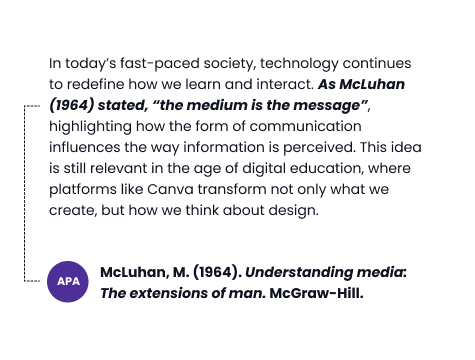
Create, manage, and reuse your citations seamlessly across all your Canva projects. With our new Citation App for Canva, you can organize your references and insert them directly into your presentations, posters, or research visuals — without ever leaving Canva.

All your citations in one place. Save your references and access them anytime across multiple projects.
Instant insertion. Add perfectly formatted citations directly to your Canva slides or designs.
Smart synchronization. Your citations stay consistent across all your projects — no need to copy and paste.
Time-saving and error-free. Focus on creating, not formatting.
Whether you’re designing for school, research, or professional presentations, our Canva App keeps your academic and creative work perfectly connected.
100% free and ad-free
Use every feature with zero cost and zero distractions.
APA 7th and 6th edition support
Create citations that match the latest APA style.
Autocite using DOI, Title, URL, or ISBN
Paste your source and let the tool do the work for you.
One-click copy
Copy your citation with a click and add it to your work.
Works with all major source types
Cite books, articles, websites, videos, and more with ease.
Staying on top of your references and citations shouldn’t take up all your time. If you’re writing a research paper, lab report, or essay, our free APA citation generator can help. Enter a title, link, or ISBN to get an accurate reference in seconds.
No sign-up. No ads. Just a simple tool to support your writing, every step of the way.
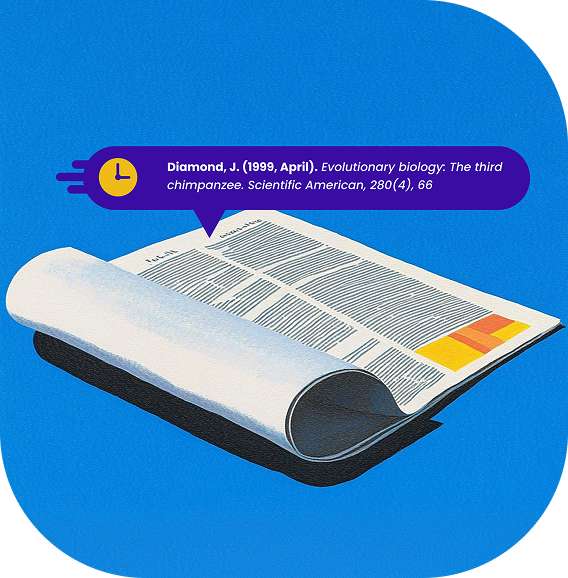
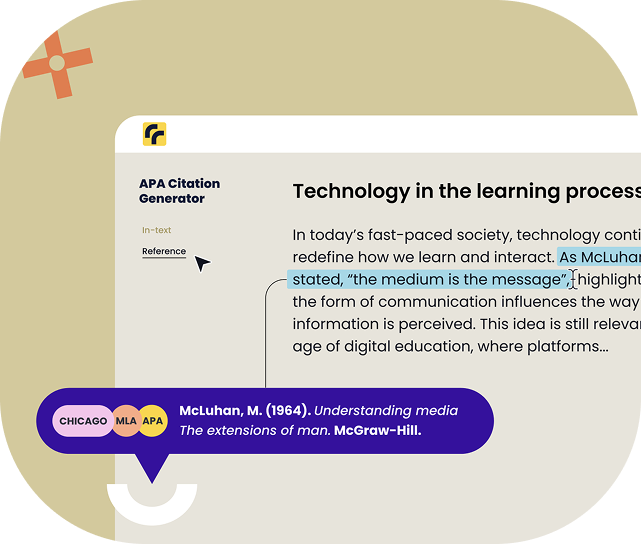
The APA Style is a comprehensive set of formal writing and citation guidelines developed by the American Psychological Association (APA) to aid reading comprehension.
Originally developed in 1929 to systemize scientific writing, it has since become one of the most widely used citation standards today and is now in its 7th edition.
The APA Style is commonly used by researchers and academics in the sciences to write journals and documentation. However, it’s also the go-to writing style for students, educators, professionals, and editors in a wide variety of fields and subjects, including nursing, engineering, sociology, and even business.
Just how prevalent is the use of APA Style? According to the APA, 70% of college students in the United States major in subjects that rely on APA guidelines for writing.
Familiarity with APA Style benefits everyone: writers and researchers can present their ideas clearly and consistently, while readers gain a smoother, more intuitive path for navigating papers and other literature. What’s more, sources of information are properly cited and given their due credit.
In this day and age, there’s an endless sea of information available at the tip of anyone’s fi ngertips. This makes it incredibly important that we’re able to tell what’s true from false. That said, fi ltering what’s reliable from what isn’t can be a lot easier said than done.
This is where APA writing and citation guidelines come in. The APA Style is a tried-and-tested tool for establishing credibility and maintaining professionalism in academic writing and research. One way to put it is that it safeguards readers and researchers against plagiarism, ambiguity, and bias!
APA style is more than just a seal of transparency and reliability of information, though. Proper citation standards also promote a deeper understanding of a topic, encouraging writers and researchers to use and be familiar with multiple sources.
APA guidelines also cover everything from basics like proper punctuation, capitalization, and margins to more specifi c topics like title page setup, in-text citations, and table formatting. They even teach us how to be inclusive in our writing, promoting bias-free language that considers all ages, genders, and ethnic identities.
The APA Style ensures that writing is clear, professional, and easily understandable between fields and disciplines, regardless of the subject matter. More importantly, it promotes a thorough research process and the use of trusted and verifi able sources.
People say that style is ever-evolving—and the same goes for writing styles. While APA Style writing and citation guidelines are authoritative, not everything contained within their guidelines is permanently set in stone. In fact, the APA Style is already in its 7th edition!
Released in 2019, the 7th edition of the APA Style guide contains more than a handful of changes from the 6th edition (released in 2009). Just how extensive are the updates? The published version of the 7th edition contains 427 pages worth of grammar, formatting, and citation guidelines. That’s over 150 pages more than its previous edition!
Below you’ll find a table containing some of the most notable differences between the two editions:
Topic
6th Edition (2009)
7th Edition (2019)
Title Page
Standardized for student and professional papers. 12-word title limit
Different formats for student and professional papers.
No word limit for title
Active vs. Passive Voice
Instructs the use of active voice
Permits use of passive voice (but encourages the use of active voice)
Paraphrasing
Requires citation for all instances of paraphrasing
Not required for every instance, but the source must be cited in the first sentence in which it is relevant
Inclusive Language
Recognizes gender diversity, but suggests alternatives to the singular use of ‘they’
Allows adjectival nouns (e.g., “the disabled”)
Singular ‘they’ endorsed as a gender-neutral pronoun
Suggests descriptive phrases (e.g., “people with disabilities”)
Linguistic Examples
Example words and letters are italicized
Example words and letters are placed in quotation marks
Citations
First citation lists all authors up to 5. In cases of more than 5 authors, list only the first author and add ‘et al’.
Any work with more than 3 authors is condensed to the name of the first author and ‘et al.’
Fonts
Two spaces after a period is accepted/preferred
Recommends a single space after each punctuation that ends a sentence
URLs
No formal instruction regarding length, the full address is usually cited
No formal instructions regarding live URLs
Leave live links for works published online
Learning APA style is an important step in writing strong academic papers. These formatting rules help your work feel professional, consistent, and credible. Below is a simple guide to the basics of APA style. You’ll find tips on how to set up your paper, format your reference list, and handle tricky citation situations.
Basic APA formatting
When setting up your paper, keep these core APA rules in mind:
APA reference list structure
Your reference list gives full details about every source you cited. Start it on a new page and label it “References” (or “Reference” if there’s only one). Center the label at the top of the page and put it in bold.
Here are the basic formatting rules to remember:
APA in-text citation rules
In-text citations show where your ideas and information came from. They connect directly to the sources in your reference list.
There are two main types of in-text citations in APA style:
Parenthetical: The author’s last name and year appear in parentheses at the end of a sentence.
Example: Taking short dance breaks while studying can boost memory (Park, 2030). Narrative: The author is part of the sentence, and the year appears in parentheses.
Example: Park (2030) suggested that taking short dance breaks while studying can boost memory.
Follow these rules to nail your in-text citations
Special APA citation cases
Some sources don’t follow the usual format. Here’s how to handle a few common ones:
No author
Start with the title instead. Italicize the title for stand-alone works (books, reports, journals) and use quotation marks if the source is part of a larger whole (articles, book chapters, web page titles).
No date
Use (n.d.) for “no date.”
Government documents
Include the author or authors (which can be a government or corporate entity), year, title of report, report number in parentheses if given, publisher, and DOI or URL.
Personal lectures or class notes
Treat this as personal communication and only cite within the text. Do not include it in the reference list.
Wikis
Include the entry title and year of the specific archived version. If the source is from Wikipedia, add “In Wikipedia” and then the URL.
Some key elements to include when citing a book in APA:
General Format
Example
In-text citation
(Last name, Year)
For direct quotes, use: (Last name, Year, Page number)
For two authors, use: (Last Name A & Last Name B, Year)
For three or more authors, use: (Last Name et al., Year)
(Bhatt, 2030)
(Bhatt, 2030, p. 20)
(Bhatt & Pascal, 2030)
(Bhatt et al., 2030)
Reference entry
Last name, Initials. (Year). Book title. Publisher.
For two authors, use: Last name, Initials. & Last Name, Initials. (Year). Book title. Publisher.
For three or more authors, use: Last name, Initials., Last Name, Initials., Last Name, Initials. & Last Name, Initials. (Year). Book title. Publisher.
(Bhatt, 2030)
Bhatt, A. & Pascal, D. (2030). The Book of Games. Folio Publishing.
Bhatt, A., Pascal, D., Rahmani, R. & Okorie, I. (2030). The Book of Games. Folio Publishing.
General Format
Example
In-text citation
(Book title, Year)
(The Secret World of Stationery, 2030)
Reference entry
Book title. (Year). Publisher.
The Secret World of Stationery. (2030). Folio Publishing.
General Format
Example
In-text citation
(Last name, Year)
For direct quotes, use: (Last name, Year, page number)
(Alcott, 2030)
(Alcott, 2030, p. 5)
Reference entry
Last name, Initials. (Year). Title of book. Publisher. URL
Alcott, N. (2030). Sleep is my superpower. Folio Publishing. https://reallygreatsite.com
General Format
Example
In-text citation
(Last name, Original publication year/Translation publication year)
(Sleet, 2030/2035)
Reference entry
Last name, Initials. (Year). Title of book (Translator’s Initial. Last name, Trans.). Publisher. (Original work published Year).
Sleet, M. (2035). A cup of tea and a chapter a day (A. Tomika, Trans.). Folio Publishing. (2030).
When citing websites in APA, include:
General Format
Example
In-text citation
(Last name, Year)
For direct quotes, use: (Last name, Year, Page number)
(Pascal, 2030)
(Pascal, 2030, para. 3)
Reference entry
Last name, Initials. (Last update or copyright date). Title of specific web page. Host site. URL
Pascal, D. (2030). How to speak fluent dog in 30 days. Bark University. https://reallygreatsite.com
General Format
Example
In-text citation
(Organization name, Year)
For direct quotes, use:
(Organization Name, Year, page or paragraph number)
(Energized, 2030)
(Energized, 2030, para. 3)
Reference entry
Organization name. (Last update or copyright date). Title of specific web page. Host site (if different from organization name). URL
Energized. (2030, March 15). How to run like a cheetah. Really Great Site. https://reallygreatsite.com
General Format
Example
In-text citation
(“Page title”, Year)
(“Why moon has craters,” 2030)
Reference entry
“Page title.” (Last update or copyright date). Host site. URL
“Why moon has craters.” (2030, March 15). Really Great Site. https://reallygreatsite.com
When citing journals in APA, include the following elements:
General Format
Example
In-text citation
(Last name, Year)
(Elsher, 2030)
Reference entry
Last name, Initials. (Year). Article title. Journal Name, Volume(Issue), Page range. DOI or URL
Elsher, M. (2030). How bad jokes improve memory recall. The Reporter, 10(5), 120-123. https://reallygreatsite.com
General Format
Example
In-text citation
(Last name, Year)
(Bekker, 2030)
Reference entry
Last name, Initials. (Year). Article title [Unpublished manuscript]. Department Name, University Name.
Bekker, Z. (2030). The power of group hugs [Unpublished manuscript]. Department One, South University
General Format
Example
In-text citation
(Last name, Year)
(Chung, 2030)
Reference entry
Last name, Initials. (Ed. or Eds.). (Year). Title of issue [Special issue]. Journal Name, Volume(Issue).
Chung, J. (Ed.). (2030). New perspectives on the cuteness of koalas [Special issue]. Fun Journal, 5(10)
When citing videos in APA, include these key elements:
General Format
Example
In-text citation
(Last name, Year)
For direct quotes, use:
(Last name, Year, Timestamp)
(Bennett, 2030)
(Bennett, 2030, 02:15)
Reference entry
Creator, A. A. (Year, Month Day). Title of video [Format]. Host site. URL
Bennett, I. (2030, March). Why do round pizzas come in square boxes? [Video]. Really Great Site. https://reallygreatsite.com
General Format
Example
In-text citation
(Last name, Year)
For direct quotes, use:
(Last name, Year, Timestamp)
Dunegan, 2030)
(Dunegan, 2030, 02:15)
Reference entry
Creator, A. A. [Screen Name]. (Year, Month Day). Title of video [Video]. YouTube. URL
Dunegan, R. [The Artist]. (2030, March 10). Why do round pizzas come in square boxes? [Video]. YouTube. https://reallygreatsite.com
When citing images, always include:
For untitled images, include a brief description in square brackets where the title would normally go. If there’s no publication date, use “n.d.” and add the access date before the URL.
General Format
Example
In-text citation
(Last name, Year)
(Park, 2030)
Reference entry
Last name, Initials. (Year). Image title [Format]. Site name. URL
Park, J. (2030). A cat’s whisker [Photograph]. Really Great Site. https://reallygreatsite.com
General Format
Example
In-text citation
(Last name, Year)
(Park, 2030)
Reference entry
Last name, Initials. (Year). Image title [Format]. Museum, Location
Park, J. (2030). A cat’s tail [Painting]. Art Museum, Any City
Some general reminders when citing other sources:
General Format
Example
In-text citation
(Last name, Year)
(Kim, 2030)
Reference entry
Last name, Initials. or Name of group. (Year, Month Day). Content of the post up to the first 20 words [Attached media, if applicable] [Type of post]. Site Name. URL
Kim, I. (2030, March 10). You deserve a break and a cookie. Productivity isn’t about being perfect [Image attached] [Status update]. Really Great Site. https://reallygreatsite.com
General Format
Example
In-text citation
(Interviewee’s initials. Last name, personal communication, Month Day, Year)
(F. Ortiz, personal communication, March 10, 2030)
Reference entry
Not included
General Format
Example
In-text citation
(Sender’s initials. Last name, personal communication, Month Day, Year)
(L. Moretti, personal communication, March 10, 2030)
Reference entry
Not included
General Format
Example
In-text citation
(Host’s last name, Year)
(Laurent, 2030)
Reference entry
Host Last name, Initials. (Host). (Year, Month Day). Title of episode (No. episode number). [Audio podcast episode]. In Podcast name. Production company. URL.
Laurent, A. (Host). (2030, March 10). Study sessions that kinda worked (No. 5). [Audio podcast episode]. In Snack Break University. Really Great Site. https://reallygreatsite.com.
FREQUENTLY ASKED QUESTIONS
